Portfolio Reporting Automation for Venture Capital Funds
Manual portfolio updates break under quarter-end pressure. Teams reconcile numbers, fix cutoffs and rebuild the same format. This blog shows how to streamline reporting so updates take minutes, not rework.

Quarterly portfolio reporting looks simple on paper. Pull the latest MIS. Update ownership and investment details. Summarise what changed. Share the report.
In reality, it is one of the most failure-prone fund workflows. Data sits across tools. Numbers move late in the cycle. Definitions drift between teams. Versions multiply over email. Then someone asks a basic question that is hard to answer quickly: what changed, why did it change and where is the supporting backup?
Most teams already have the data. The pain comes from converting that data into a consistent, repeatable portfolio company report every quarter.
Taghash Portfolio reduces reporting friction with template-driven report generation. Upload a Word template with placeholders once. Taghash pulls accurate values from portfolio records and MIS already inside the platform. It then generates a formatted portfolio company update you can download instantly or receive by email.
This is built for funds that want reporting to run like a controlled process, not a quarter-end hassle.
What this feature is
Inside Taghash Portfolio, you can auto-generate portfolio company updates using your own reporting template. The template carries your structure and Taghash fills it with the right data every time.
A template is a Word document that includes:
- Your fund’s standard headings and narrative sections
- Placeholders for key fields like company name, sector, valuation, stake and key updates
- Tables that auto-populate, such as transaction history and quarterly or yearly MIS snapshots
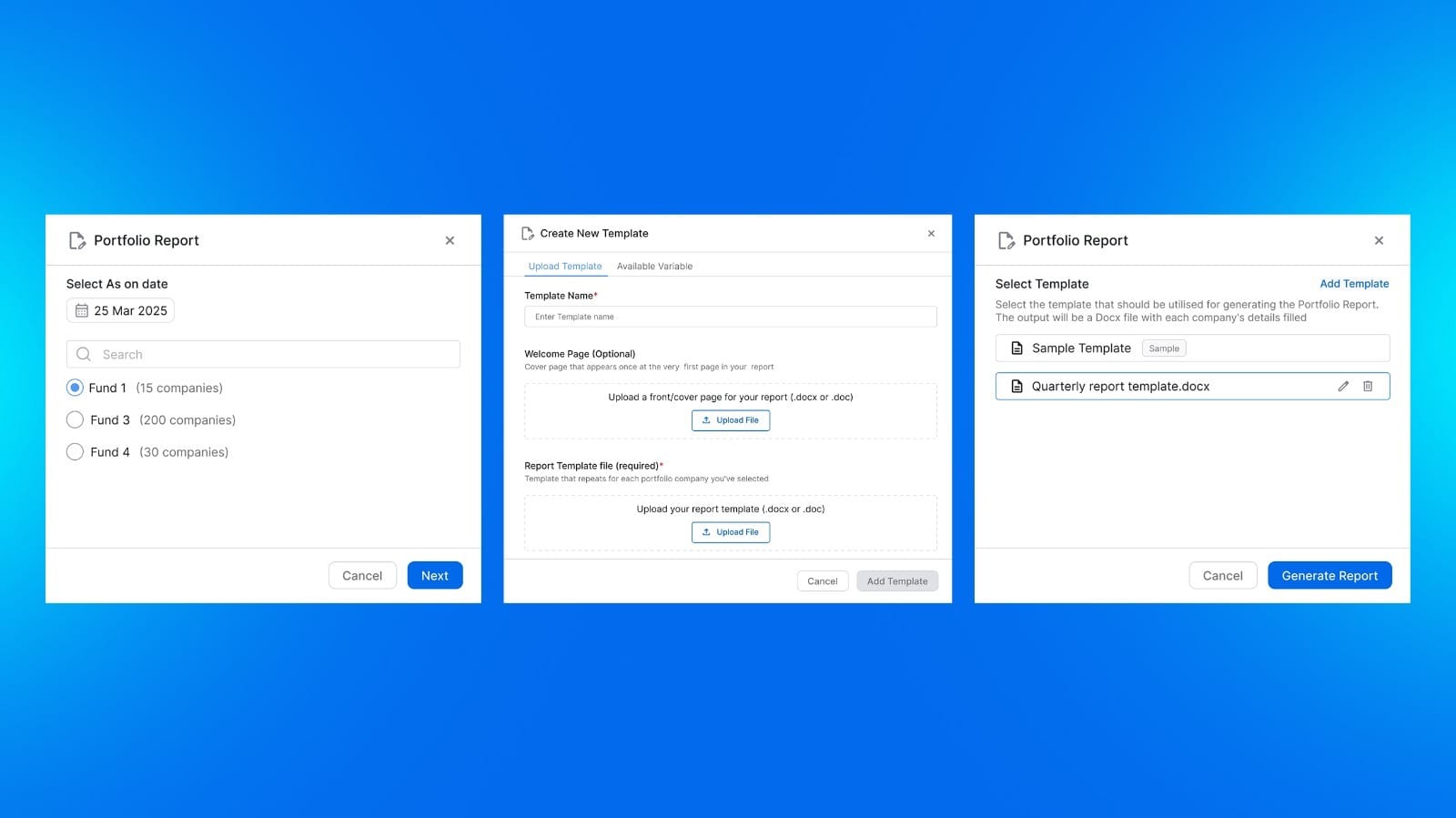
When you click Generate Report in Taghash Portfolio, the flow stays consistent each time:
- Select the fund
- Define the “as on” date
- Upload your template with the correct placeholders
- Generate the report
- Download it from Taghash and optionally receive it by email
Every output follows your format. Every field pulls from the platform.
Why this matters for fund teams
Each benefit below maps to a common failure point in quarterly reporting and explains what improves when the workflow becomes template-driven.
1) Reporting supports governance and audit trail
Portfolio reporting influences LP trust, internal decision-making, audit readiness and IC quality. When reporting is inconsistent, teams spend time on follow-ups, rechecks and explanations.
A static template creates a stable reporting standard. It maintains consistency across quarters and across team members. It also strengthens the audit trail.
2) Consistent structure improves review quality
Portfolio reviews work better when updates are comparable over time. A consistent frame keeps discussions anchored and makes it easier to spot the signal.
If the structure changes each quarter, it becomes harder to spot the signal. If fields are missing, stakeholders fill gaps with assumptions. If KPIs move without context, the conversation drifts into debate instead of action. Template-driven reporting creates a consistent frame that keeps discussions anchored.
3) MIS adds value when it directly drives the reporting output
MIS is most useful when everyone works from the same numbers. Keeping MIS inside the system reduces inconsistencies and shortens review cycles.If numbers are copied and pasted across tools, inconsistencies show up and reduce confidence. When MIS stays inside the system and flows into reporting, review becomes faster and disputes become easier to resolve.
4) Quarter selection becomes deterministic
A common issue in quarterly packs is a reporting cut-off mismatch. The “as on” date flow helps keep period selection consistent across the team.
One person uses a different “as on” date, another uses a different quarter cut and the pack becomes hard to reconcile. Set the date and Taghash picks the relevant quarters.
5) Templates save time for better judgement
Templates remove repetitive manual work so teams can spend time on the parts that need judgement and context.
As a result, less time is spent on formatting and reconciliation and more time on the work that matters, such as variance explanations, key updates, risks and next steps.
How to generate a portfolio report in Taghash
The steps below reflect the exact workflow a fund team follows inside Portfolio, from template setup to quarterly reuse.
Step 1: Create your Word report template
Start with the structure you already use for LP updates or internal reviews. Insert placeholders for the fields you want Taghash to fill. Keep headings, tables and narrative blocks exactly as you want them to appear.
Step 2: Keep the portfolio and MIS fields clean inside Taghash
A clean dataset makes the report generation stronger and more reliable. Here are the main ways teams set this up:
- Add new fields to match your reporting requirements
- Customise fields such as KPI labels, internal tags and key update sections
- Use the MIS data already uploaded inside Taghash, so reports pull the latest values
Step 3: Generate the report from Portfolio
Once your template is ready, generating the report is a short repeatable flow:
- Click Generate Report
- Choose the fund
- Set the “as on” date
- Upload the template
- Generate and download
- Receive the report by email when needed
Step 4: Reuse the template next quarter
Next quarter, change only the “as on” date. Taghash generates the same layout with updated MIS snapshots and updated portfolio fields. The structure stays stable and comparisons become easier.
Common use cases
This feature fits best wherever the same update format repeats across companies and across quarters. Teams typically use it for:
- Quarterly portfolio company one-pagers for LP reporting
- IC pre-reads and internal portfolio reviews
- Deal team updates where ownership, investment details and MIS snapshots need consistent presentation
- Exit planning notes where the structure stays constant across multiple companies
In a nutshell
Taghash turns quarterly portfolio reporting into a repeatable workflow. Your report format stays consistent across quarters. Your data stays accurate because it is pulled from Taghash MIS and portfolio records.
Review cycles shorten because version control improves and reconciliation work reduces. Teams spend more time on judgement, narrative clarity and decisions.
About Taghash
Taghash provides an end-to-end platform for venture funds, private equity, fund of funds and other alternative investment funds. Over the last seven years, we have served as the tech arm for top VCs, helping them manage operations across deal flow, portfolio, fund and LP management.
We also offer a services layer to support execution across data management, legal and compliance, fund administration coordination, trustee and custodian interfacing and valuations and advisory.
Trusted by leading fund managers like Blume Ventures, Kalaari Capital and A91 Partners, we enable our clients to achieve greater success. Click here to book a demo.