


LP consent involves more than collecting votes. This blog explains how AIF teams can manage investor selection, voting rules, weighted approvals, reminders and audit-ready records through a structured LP consent workflow.

Tanupreet Kaur
Sep 25, 2026
-
10
min to read

LP consent can look simple from the outside. Send the proposal, collect responses, check the threshold, and close the vote.
Fund teams know there is more to it.
You need to know which LPs should receive the request, what they were shown, which voting rule applies, how each response is weighted, what happens when someone does not respond, and how the final percentage was calculated.
If the decision is reviewed months later, the team should be able to follow the full history without rebuilding it from inboxes and spreadsheets.
SEBI’s June 30, 2026 consultation paper brings many of these questions into focus. It proposes a more standard approach to investor consent across AIFs, covering consent methodologies, non-response, disclosures, approval thresholds, and recordkeeping.
As of September 21, 2026, these methodologies remain proposals under consultation. SEBI lists the AIF Regulations as last amended on July 14, 2026.
LP voting and consent management covers the full process around an investor approval request.
A fund team creates the proposal, identifies the relevant LPs, shares supporting documents, sets the voting rules, collects responses, calculates the outcome, and keeps the final record.
This becomes harder when each part lives somewhere different. The investor list may be in the fund system. Voting weights may be in a spreadsheet. Responses may arrive over email. Reminders may be tracked separately.
Taghash keeps these parts linked to the fund and its existing LP records.
SEBI’s consultation paper discusses three approaches.
Deemed Consent: An investor who does not respond within the stated timeline is treated as having approved the proposal.
Present and Voting: Only investors who participate are included in the calculation. Non-participants are excluded.
Express Voting for Approval: Only explicit votes in favour count toward the required threshold, measured against total investor value.
The difference matters.
In SEBI’s example, investors representing 30% by value vote in favour, 10% vote against, and 60% do not participate. The same responses result in different approval percentages depending on the methodology: 90% under deemed consent, 75% under present and voting, and 30% under express voting.
The same investor responses can therefore produce very different outcomes depending on the methodology.
SEBI’s paper also proposes disclosure of the selected method, the reason for the proposal, the provision requiring consent, the approval threshold, treatment of non-response, and records of notices, reminders, meetings, and votes.
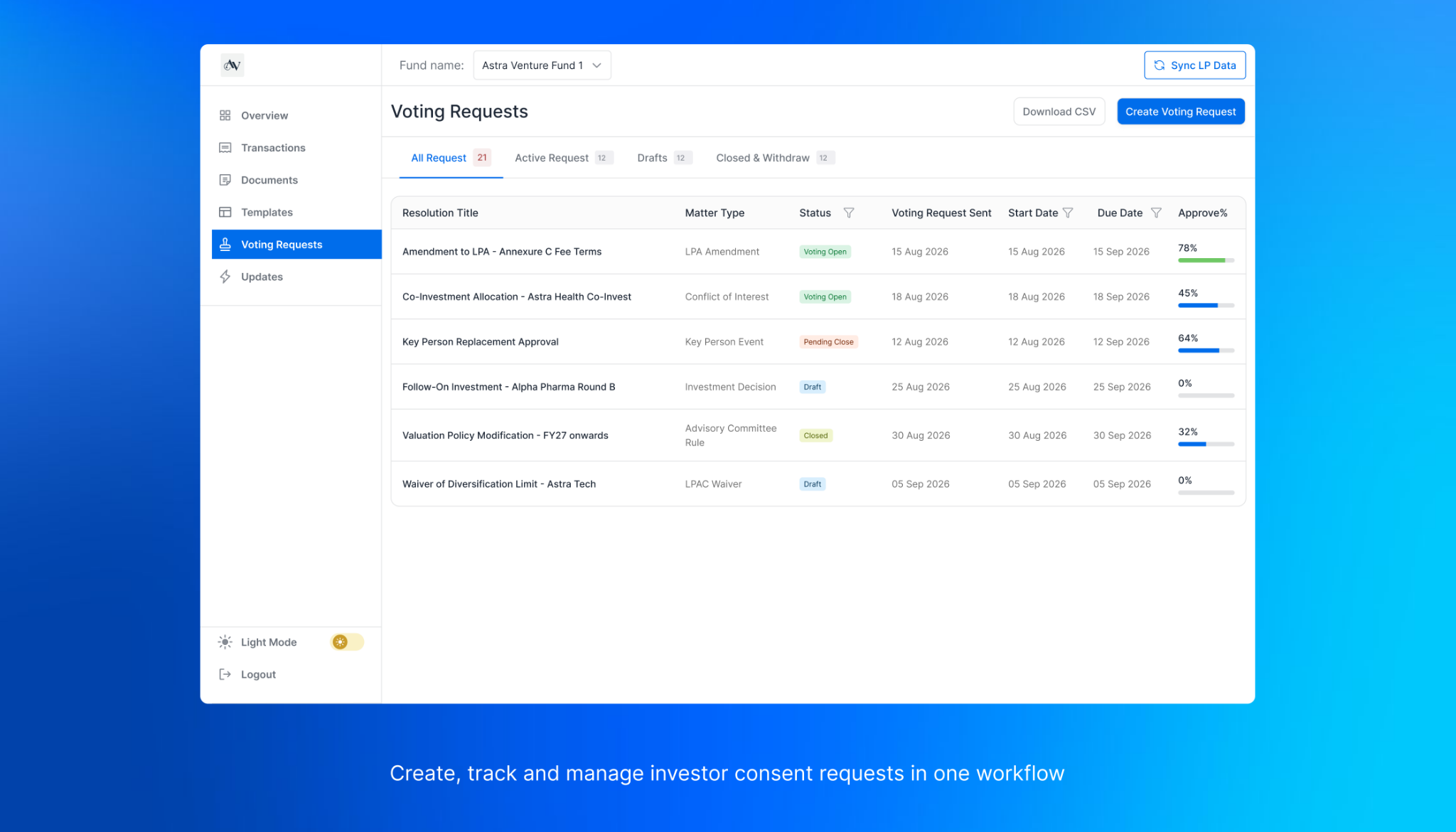
The Fund Admin starts with the decision itself.
The request can include the title, matter type, investor-facing description, effective date, SEBI regulation reference, PPM clause reference, and supporting documents.
For a PPM amendment, term extension, side-letter change, or similar consent event, the investor can review the relevant information before voting.
LPs load from the relevant fund in Taghash.
The Admin selects the investors who should receive the request, based on the applicable regulation and fund documents.
Committed amount and units held are captured for the request. This preserves the investor data linked to the vote even if fund records change later.
This is where the calculation is defined.
Consent Methodology determines how non-responses are treated. Taghash supports Present & Voting, Deemed Consent, and Express Voting.
Voting Basis determines how each LP’s response is weighted. Taghash supports One LP One Vote, By Units, and By Value.
Approval Threshold sets the percentage required for approval.
The Fund Admin can also set when voting opens and closes.
These settings answer different questions. How should participation be treated? How much weight does each response carry? What percentage is required to approve the proposal?
Where SEBI or the governing documents require approval by value, the required value basis should be used.
Before sending, the Admin reviews the matter, selected LPs, documents, voting window, and voting rules.
Once the request goes out, the methodology, basis, and threshold are locked.
That gives the fund a fixed calculation framework for the life of the vote. The rules used to produce the final result cannot be changed midway through the process.
Each selected LP receives the request by email and through the Taghash LP portal.
The LP reviews the proposal and supporting documents, then chooses Approve, Reject, or Abstain.
Each submission is verified through a one-time passcode sent to the LP’s registered email.
Once cast, the vote is final and cannot be edited. Taghash records the submission timestamp and IP address as part of the audit history.
If Abstain is available as a separate response, the fund should define its treatment before the request goes out.
Fund ops and IR teams can monitor delivery, opens, responses, and outstanding LPs while voting is active.
Scheduled or one-off reminders can be sent to investors who have not responded.
There is no separate follow-up sheet to maintain and no need to manually check who still needs a reminder.
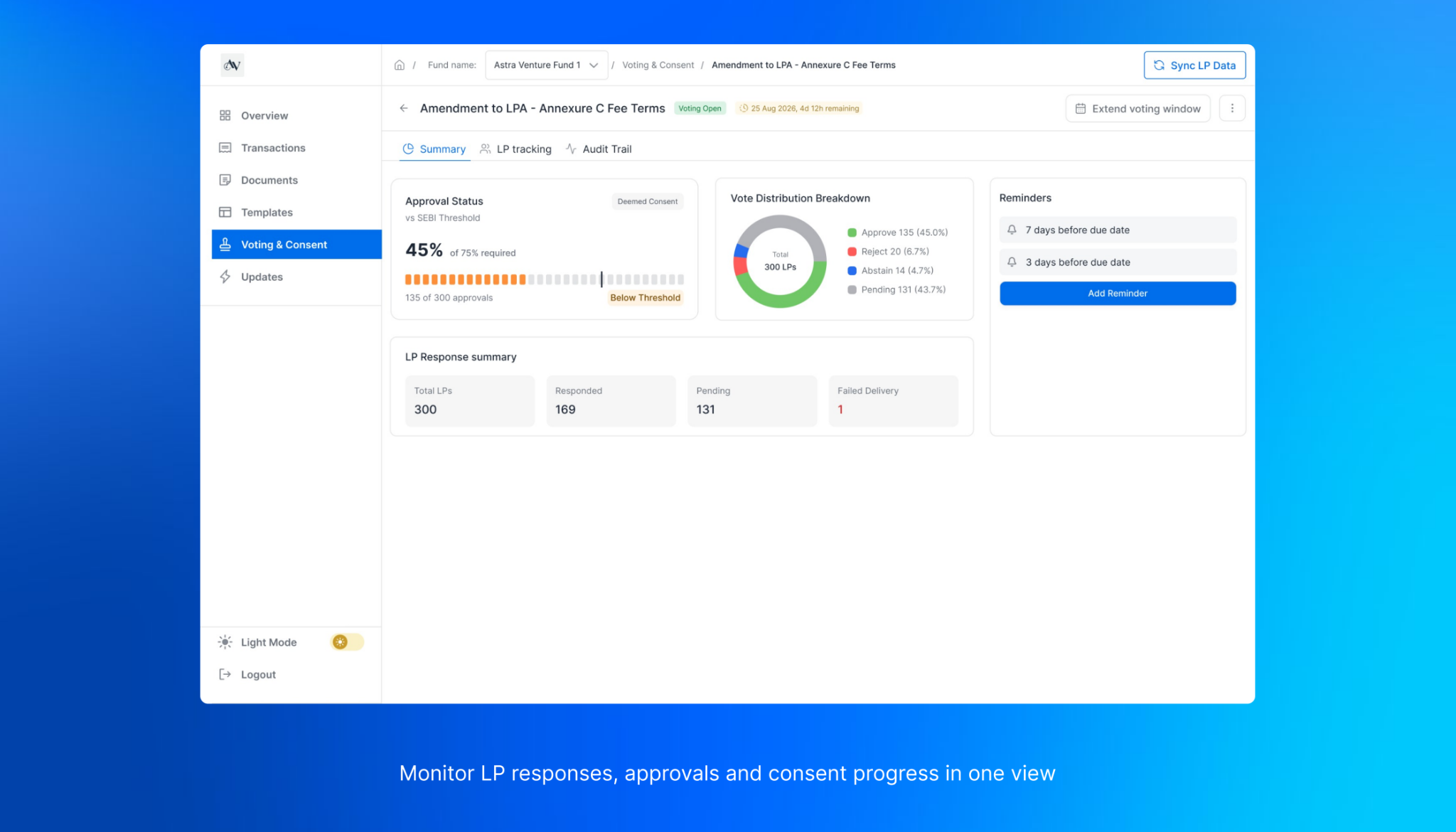
When voting closes, Taghash applies the locked Voting Basis, handles non-responses under the selected Consent Methodology, and compares the result with the Approval Threshold.
The outcome is recorded as Approved or Rejected.
For weighted votes, this removes the manual work of matching responses back to investor values and recalculating percentages in spreadsheets.
The value of the process becomes even more important after the vote closes.
Taghash keeps the LP population, voting data, responses, timestamps, and final outcome linked to the consent request.
Reports can be exported in PDF or CSV format for internal governance, investor queries, audits, or regulatory review.
If someone asks how the fund reached the decision six months later, the team can follow the record from request to result.
Before dispatch, confirm the matter and rationale, the provision requiring consent, the eligible LP population, the voting basis, the treatment of non-response and abstention, and the approval threshold.
These settings should be checked against the latest SEBI requirements and the fund’s governing documents.
Taghash applies the rules configured by the fund team. Legal and compliance teams remain responsible for determining which rule applies.
Taghash connects LP voting with the fund data already used by PE, VC, and AIF teams.
The same workflow covers proposal setup, LP selection, locked voting rules, verified submissions, reminders, weighted calculations, and the final audit record.
For fund teams, this means fewer handoffs between investor data, email, spreadsheets, and reporting when a consent event needs to be run and later reviewed.
Request a demo today to see how LP Voting works in Taghash.
About Taghash
Taghash provides an end-to-end platform for venture funds, private equity, fund of funds and other alternative investment funds. Over the last seven years, we have served as the tech arm for top VCs, helping them manage operations across deal flow, portfolio, fund and LP management.
We also offer a services layer to support execution across data management, legal and compliance, fund administration coordination, trustee and custodian interfacing and valuations and advisory.
Trusted by leading fund managers like Blume Ventures, Kalaari Capital and A91 Partners, we enable our clients to achieve greater success.
View all

For AIFs subject to the annual PPM compliance audit, 30 September 2026 is the reporting deadline for FY 2025-26. This guide covers audit applicability, exemptions and the key considerations for fund teams preparing for the deadline.

LP consent involves more than collecting votes. This blog explains how AIF teams can manage investor selection, voting rules, weighted approvals, reminders and audit-ready records through a structured LP consent workflow.

IFSCA has introduced the Fund Management (Second Amendment) Regulations, 2026, bringing changes across Venture Capital, Restricted and Retail schemes. This blog covers the key updates to pre-close deployment, NAV and portfolio reporting, FME contributions, distribution rights, scheme documentation and governance.