


AIF classification is not always as straightforward as fund labels suggest. This blog explains how Category I, II and III AIFs differ from Angel Funds, AI-only Funds, LVFs and CIVs, and why correct classification matters for fund structure, investor eligibility and compliance.

Tanupreet Kaur
Aug 14, 2026
-
13
min to read

India’s Alternative Investment Fund ecosystem has expanded significantly over the past decade. Alongside familiar labels such as venture capital funds, private equity funds and hedge funds, the regulatory framework now includes Angel Funds, Accredited Investors only Funds, Large Value Funds and Co-investment Vehicle Schemes.
However, these terms do not all represent separate categories of funds.
Under the SEBI (Alternative Investment Funds) Regulations, 2012, every AIF is registered under one of three principal categories: Category I, Category II or Category III. Angel Funds and Special Situation Funds are defined subcategories. AI-only Funds and Large Value Funds describe the eligibility of investors and the regulatory framework available to a scheme. A Co-investment Vehicle, meanwhile, is a deal-specific scheme associated with an existing AIF.
Understanding these distinctions is important because a fund’s classification determines what it may invest in, whether it may use leverage, who may invest, how long it may operate and which regulatory requirements it must follow.
An Alternative Investment Fund, or AIF, is a privately pooled investment vehicle that collects capital from Indian or foreign investors and invests it according to a defined investment policy.
AIFs are different from retail investment products such as mutual funds. They are generally designed for sophisticated investors and are privately placed rather than offered publicly.
SEBI divides AIFs into three categories based primarily on their investment strategy, portfolio composition and use of leverage.
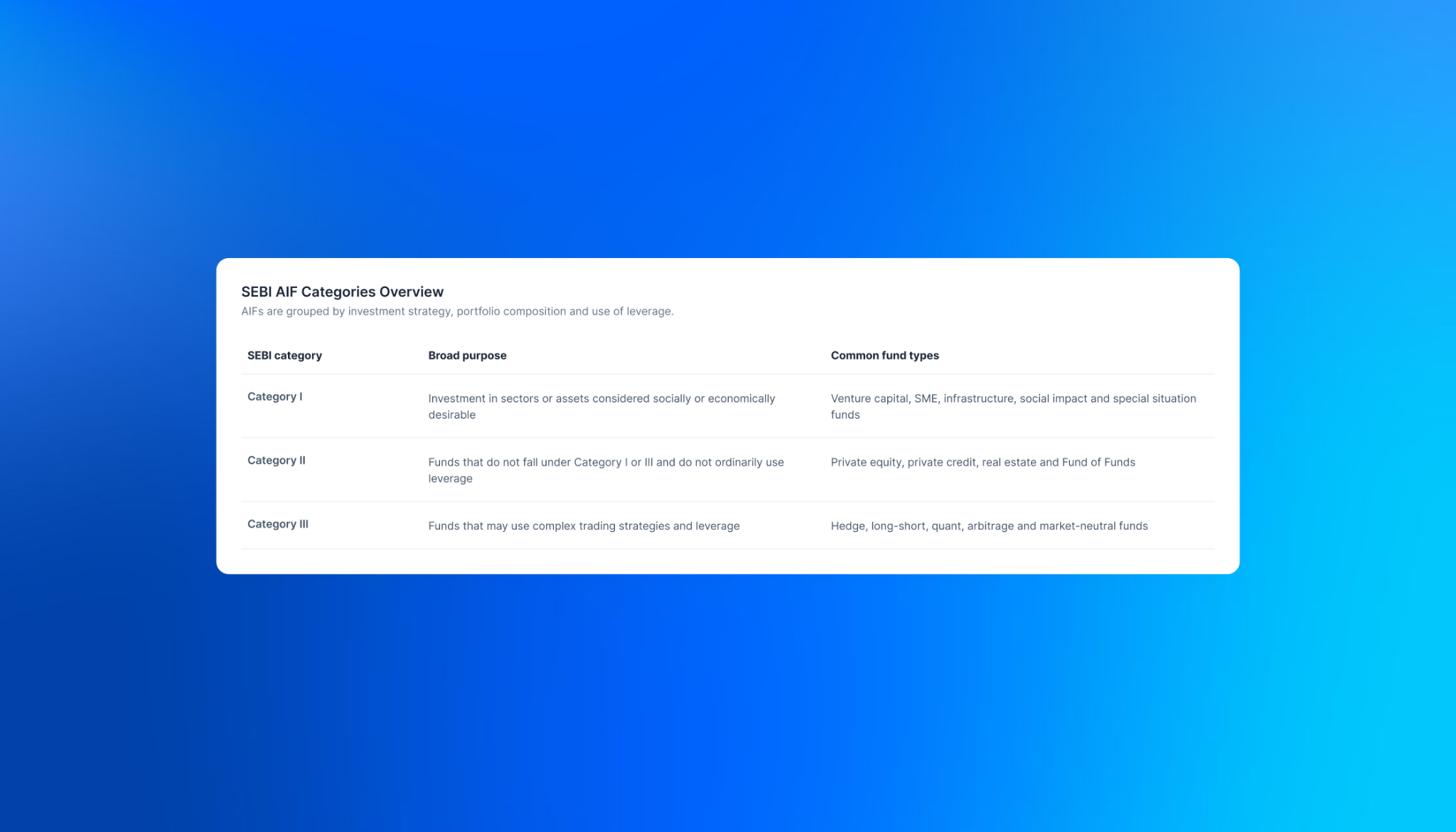
Category I AIFs invest in start-ups, early-stage businesses, social ventures, SMEs, infrastructure and other areas that may contribute to economic or social development.
Category I currently includes several recognised subcategories.
Venture Capital Funds primarily invest in unlisted securities of venture capital undertakings. They are commonly used for investing in start-ups and emerging businesses.
Labels such as seed fund, early-stage fund, deep-tech fund, climate-tech fund or healthcare venture fund usually describe the investment strategy. They do not constitute separate SEBI categories.
For example, a fund investing exclusively in artificial-intelligence start-ups may still be registered as a Category I Venture Capital Fund. Its sector focus does not create a new regulatory category.
An Angel Fund is a specific subcategory of Venture Capital Fund under Category I. Unlike a conventional VC fund, it generally follows a deal-by-deal participation model under which eligible investors may choose whether to participate in individual start-up investments.
SEBI substantially revised the Angel Fund framework in September 2025.
Under the revised framework, Angel Funds must onboard and offer investment opportunities only to Accredited Investors. These investors must meet SEBI’s prescribed financial or eligibility criteria and obtain certification from a SEBI-recognised Accreditation Agency.
The revised framework also introduced greater investment flexibility:
An Angel Fund should not be confused with every fund that invests at the angel or pre-seed stage. A conventional Venture Capital Fund may invest in very early-stage businesses without being registered as an Angel Fund.
SME Funds invest primarily in small and medium enterprises. Their portfolio may include unlisted SME securities and securities of companies listed or proposed to be listed on SME exchanges, subject to the AIF Regulations.
These funds are intended to provide growth capital to smaller businesses that may not yet have access to larger institutional or public-market funding.
Infrastructure Funds invest primarily in infrastructure companies, infrastructure projects or permitted infrastructure-related securities.
Their mandates may cover sectors such as energy, transport, logistics, telecommunications and digital infrastructure, provided the investments satisfy the applicable regulatory definition.
Previously known as Social Venture Funds, Social Impact Funds invest in social ventures or social enterprises.
Their objective is to combine capital deployment with a defined social purpose. Their documentation and operating framework may also contain specific provisions relating to social outcomes, disclosures and impact measurement.
Special Situation Funds invest in specified special situation assets, including eligible stressed assets, stressed loans and security receipts.
They operate within both SEBI’s AIF framework and the relevant RBI framework governing the transfer and resolution of stressed loans.
A Special Situation Fund is therefore different from a fund that simply uses “special opportunities” as a marketing description. To operate as a Category I Special Situation Fund, its portfolio must meet the applicable regulatory conditions.
The Corporate Debt Market Development Fund, or CDMDF, is also classified as a Category I AIF.
It is a specialised backstop facility designed to purchase investment-grade corporate debt securities during periods of market stress. It is not the same as an ordinary private credit or debt fund established for commercial investment purposes.
Category II is the broad residual category under the AIF Regulations. It covers funds that do not qualify as Category I and do not use the complex trading or leverage strategies associated with Category III.
Common Category II strategies include:
These are generally market descriptions rather than separate statutory subcategories.
A “private equity fund”, for example, is usually registered as a Category II AIF. A “real estate fund” also typically falls under Category II, depending on the securities and assets in which it invests.
Category II funds cannot use borrowing or leverage as a regular investment strategy. Limited borrowing may be permitted for temporary funding requirements and specified drawdown shortfalls, subject to SEBI’s conditions.
Like Category I AIFs, Category II AIFs are generally close-ended and ordinarily have a minimum tenure of three years.
Category III AIFs may employ complex or diverse trading strategies and may use leverage, including through derivatives.
Common examples include:
Category III schemes may be open-ended or close-ended.
Because these funds may use leverage, they are subject to additional requirements relating to leverage limits, risk management, stress testing, disclosure and regulatory reporting.
However, not every Category III AIF necessarily uses high leverage. Similarly, not every fund investing in listed equities automatically becomes a Category III AIF. The classification depends on the strategy, investment powers and risk framework disclosed in the fund’s Placement Memorandum.
In the AIF regulatory framework, “AI” means Accredited Investor—not artificial intelligence.
An Accredited Investors only Fund, or AI-only Fund, is an AIF or scheme in which every relevant investor is an Accredited Investor. Certain exclusions apply to specified investors associated with the Sponsor, Manager or AIF.
An AI-only Fund is not a fourth AIF category. It may be registered under Category I, Category II or Category III.
For example:
The underlying category continues to determine the scheme’s permitted investments, use of leverage and other core regulatory obligations.
Accredited Investors are investors who satisfy SEBI’s prescribed net-worth, income or other eligibility criteria and receive accreditation from a recognised Accreditation Agency. Their verified sophistication allows SEBI to provide specified regulatory flexibility to schemes restricted to such investors.
However, AI-only status does not remove the requirement to comply with the AIF Regulations, PPM terms, AML and KYC requirements, governance obligations or investor-protection standards.
SEBI’s December 2025 circular also prescribed a formal process for eligible existing schemes to migrate to AI-only status. A fund cannot simply describe itself as AI-only because its existing investors happen to be accredited.
A Large Value Fund for Accredited Investors, or LVF, is a specialised form of AI-only Fund.
Following the November 2025 amendments, each relevant investor in an LVF must:
The threshold was previously ₹70 crore.
An LVF may operate within Category I, Category II or Category III. It is not an independent AIF category.
LVFs receive certain regulatory concessions because their investors are both accredited and committing substantial capital. Depending on the applicable category and framework, these may include:
The relationship between the two structures can be stated simply:
Every LVF is an AI-only Fund, but every AI-only Fund is not an LVF.
An AI-only Fund does not have to satisfy the ₹25 crore per-investor LVF threshold. An LVF does.
SEBI introduced the Co-investment Vehicle Scheme framework in September 2025.
It enables Category I and Category II AIFs to offer co-investment opportunities to their Accredited Investors within the AIF structure. Before this framework, co-investments were commonly facilitated through the co-investment Portfolio Management Services route or separate contractual structures.
A CIV is neither a general sidecar fund nor another AIF category. It is an affiliate scheme linked to a main AIF scheme and a specific investee company.
The important features include:
CIV Schemes receive targeted exemptions from requirements that would not be practical for a single-deal vehicle, including the ordinary minimum corpus, tenure and concentration rules.
They remain governed by Regulation 17A of the AIF Regulations, SEBI’s CIV circular, the Shelf PPM and applicable implementation standards.
Many fund names used in the market describe the strategy rather than the regulatory classification.
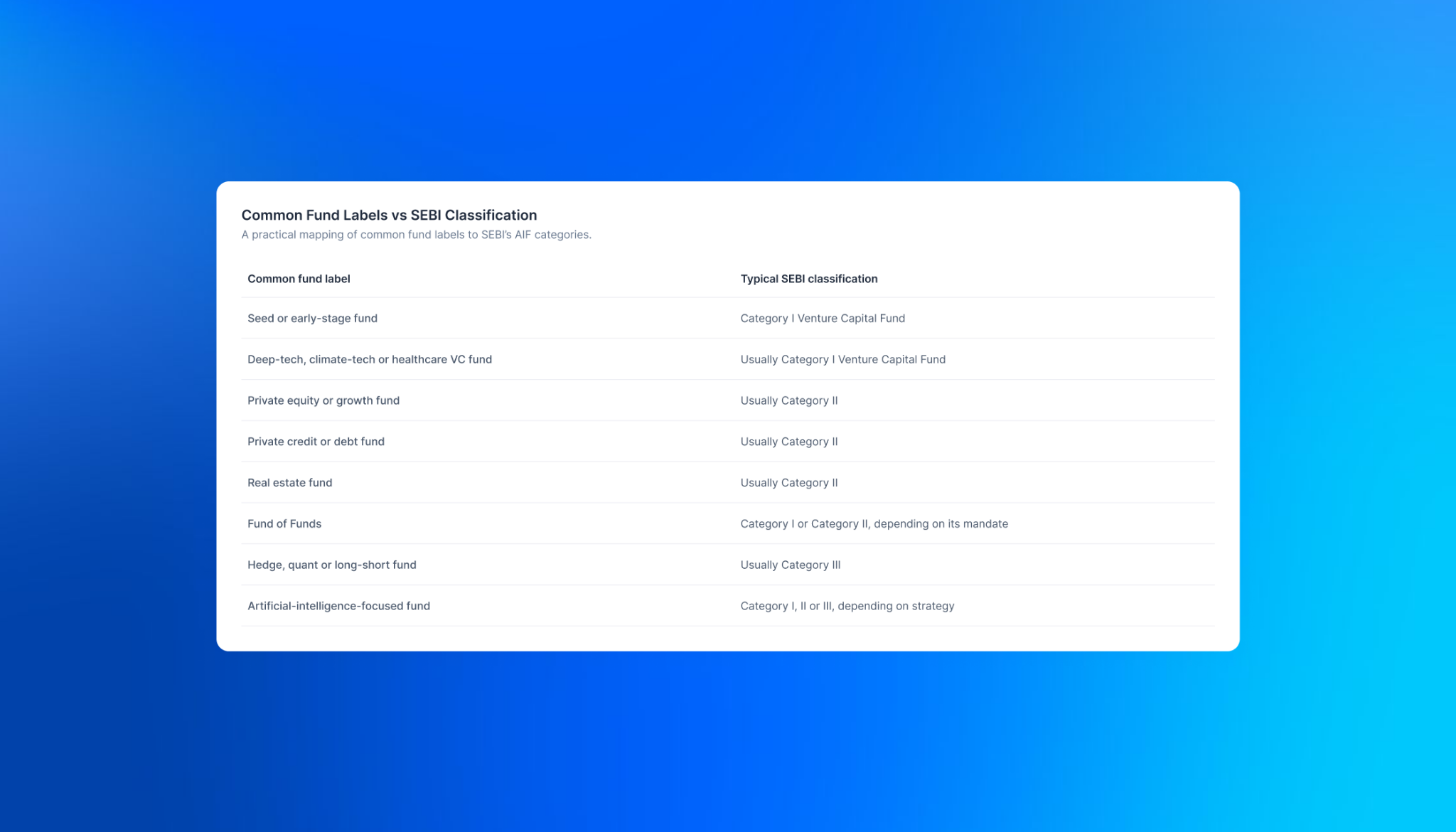
The distinction between an artificial-intelligence-focused fund and an AI-only Fund is particularly important.
An artificial-intelligence-focused fund invests in AI companies or technologies. An AI-only Fund restricts participation to Accredited Investors. The two expressions refer to entirely different things.
Although special frameworks and exceptions may apply, some baseline rules are useful for understanding ordinary AIF schemes:
These numbers should always be checked against the fund’s category, PPM and any special exemptions available to the scheme.
The AIF framework changed significantly during 2025–26.
SEBI allowed Category I and II AIFs to offer deal-specific co-investments to Accredited Investors through CIV Schemes operating within the AIF structure.
Angel Funds moved to an Accredited Investors-only model. SEBI also revised their investment limits, concentration treatment and investor-participation rules.
SEBI formally expanded the AI-only Fund framework, reduced the LVF minimum commitment from ₹70 crore to ₹25 crore and issued modalities for existing schemes seeking to migrate.
SEBI issued updated requirements for regulatory reporting by AIFs, requiring managers to align their data, systems and submission processes with the revised framework.
On 3 June 2026, SEBI issued an updated Master Circular consolidating the operational requirements applicable to AIFs, including the newer Angel Fund, AI-only, LVF and CIV frameworks.
SEBI introduced a framework dealing with the retention of proceeds and “Inoperative Fund” status during the winding-up of AIF schemes. This provides a regulated route for specified situations in which a scheme has substantially completed its exit process but certain proceeds or obligations remain unresolved.
The SEBI AIF Second Amendment Regulations, 2026 reduced the advance PPM filing period for applicable schemes from 30 days to 10 working days. The amendment also exempted an AIF’s first scheme from the applicable scheme filing fee.
On 30 July 2026, SEBI introduced the Green-Channel: AIF Rollout Upon Document Acknowledgement, or GARUDA, mechanism.
Under the applicable route, an eligible scheme may proceed with its launch following acknowledgement of the prescribed documents or completion of the relevant period, subject to merchant-banker review and SEBI’s conditions.
GARUDA accelerates the scheme-launch process. It does not remove the requirement for a compliant PPM or prevent SEBI from reviewing the documents and raising observations after filing.
Fund managers should consider the following questions in sequence:
The fund’s name or marketing description cannot override its registration category or PPM.
Category I, Category II and Category III remain the legal foundation of SEBI’s AIF framework.
Within that foundation:
The practical challenge for fund managers is to classify every layer correctly: the legal AIF category, any recognised subcategory, the investor-eligibility framework and the scheme structure.
That classification must then remain consistent across the PPM, investor onboarding, capital commitments, investment controls, reporting and investor communications.
Regulatory position checked as of 11 August 2026. This article is intended as a general regulatory explainer and does not constitute legal, tax or investment advice. Fund managers should review the latest SEBI regulations, circulars, Master Circular, implementation standards and scheme-specific documents with professional advisers before acting.
About Taghash
Taghash provides an end-to-end platform for venture funds, private equity, fund of funds and other alternative investment funds. Over the last seven years, we have served as the tech arm for top VCs, helping them manage operations across deal flow, portfolio, fund and LP management.
We also offer a suite of services like Contributor onboarding/servicing, Fund accounting, Fund administration, Compliance Management, Reporting & Portfolio management and Tax compliance.
Trusted by leading fund managers like Blume Ventures, Kalaari Capital and A91 Partners, we enable our clients to achieve greater success. Click here to book a demo.
View all


For AIFs subject to the annual PPM compliance audit, 30 September 2026 is the reporting deadline for FY 2025-26. This guide covers audit applicability, exemptions and the key considerations for fund teams preparing for the deadline.

LP consent involves more than collecting votes. This blog explains how AIF teams can manage investor selection, voting rules, weighted approvals, reminders and audit-ready records through a structured LP consent workflow.

IFSCA has introduced the Fund Management (Second Amendment) Regulations, 2026, bringing changes across Venture Capital, Restricted and Retail schemes. This blog covers the key updates to pre-close deployment, NAV and portfolio reporting, FME contributions, distribution rights, scheme documentation and governance.