


See how the Taghash WhatsApp Agent helps VC, PE and fund teams reduce workflow friction. Access permissioned deal, portfolio and fund context directly through everyday WhatsApp conversations now.

Tanupreet Kaur
Aug 26, 2026
-
10
min to read
A founder sends a pitch deck while you are between meetings. You need the last four quarters of portfolio MIS before a board call. A follow-up is due, but the relevant context sits across deal records, notes, documents and previous activity.
In many cases, the information already exists. The time goes into finding it, understanding it and carrying the next action forward.
The Taghash WhatsApp Agent gives VC firms, PE firms and fund teams a conversational way to work with permissioned Taghash data and supported workflows directly through WhatsApp.
Users can research companies, retrieve deal, portfolio, fund context, enrich records, update supported fields, add notes and reminders, review portfolio MIS, prepare charts and move supported actions forward without navigating through multiple screens for every step.
WhatsApp becomes another interface for working with Taghash. The underlying records, permissions, documents and workflow context remain connected inside the platform.
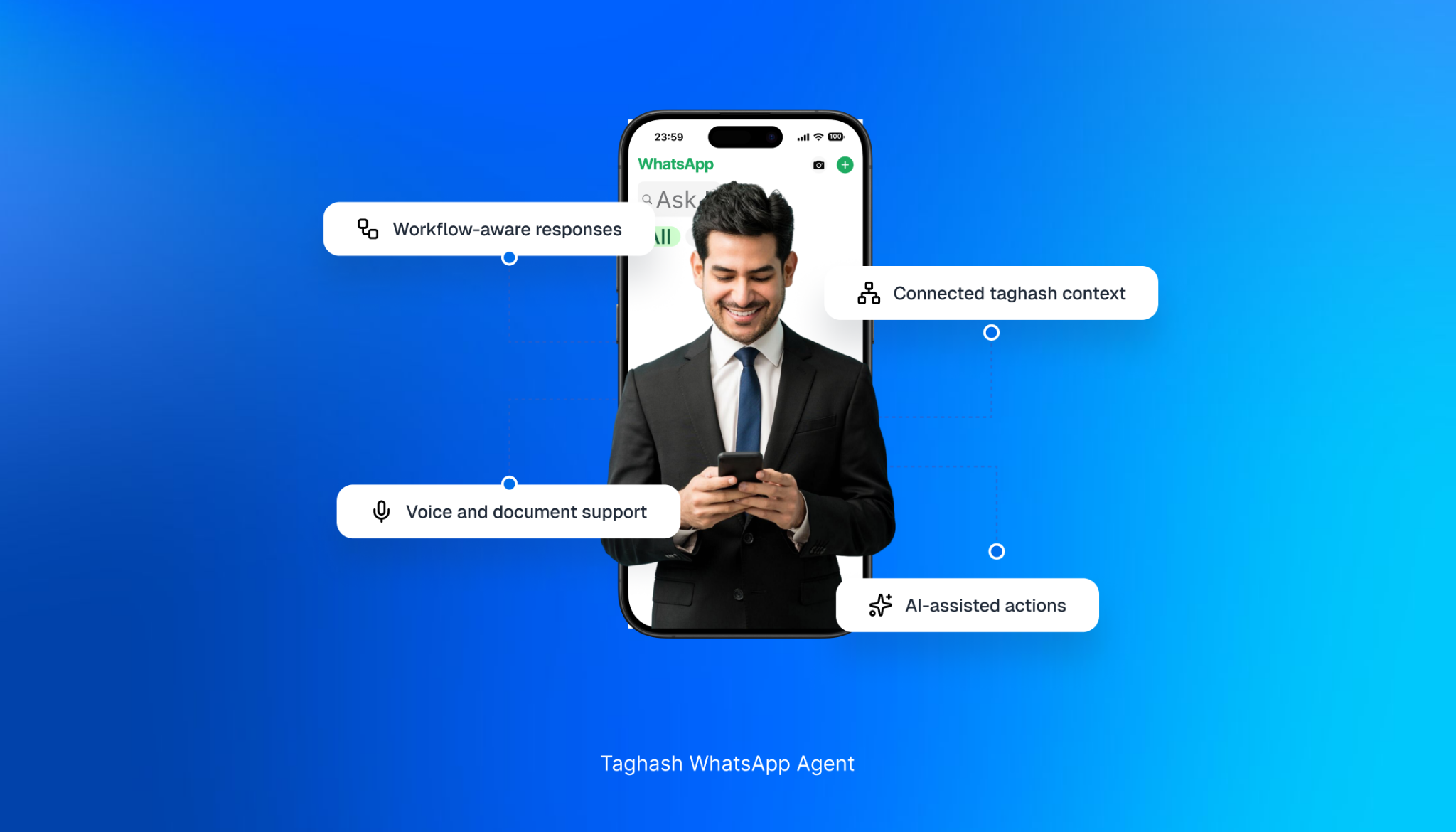
The Taghash WhatsApp Agent is a conversational AI interface for workflows already managed in Taghash.
Instead of navigating through separate screens to check a deal, find a reminder, review portfolio information or prepare an update, users can ask for the relevant context through WhatsApp.
The Agent can work across:
The important difference is what happens after a question.
The Agent can use the permissioned Taghash context available to the user, carry relevant context into the next instruction and move supported workflows forward.
Fund teams rarely work inside one application throughout the day.
Founder conversations happen over calls and messages. Pitch decks arrive through email or WhatsApp. Portfolio companies submit MIS. Investment teams track notes, reminders and follow-ups. Fund and LP information sits alongside documents, transactions and reporting records.
The extra work begins when someone has to reconnect that information manually.
A pitch deck arrives in one channel. Research happens somewhere else. The deal record is updated separately. A reminder is created later. By the next discussion, someone may need to reconstruct the context again.
The WhatsApp Agent shortens that gap.
A conversation that begins in WhatsApp can work with the permissioned deal, portfolio, fund context already maintained in Taghash.
At a workflow level, the Taghash WhatsApp Agent follows a consistent pattern.
1. The user sends an instruction through WhatsApp.
This can be a text message, document or voice note.
2. The Agent identifies the request and relevant Taghash context.
It connects the instruction with the records and workflow information available to that user.
3. It retrieves the information required for the task.
This may include Taghash data, uploaded documents or external research when the user requests it.
4. It analyzes or organizes the information.
For example, it can summarize activity, and compare portfolio data.
5. It returns the result or moves a supported action forward within the user's permissions and review controls.
This can include enriching records, creating reminders, generating charts or preparing documents.
6. Relevant workflow context can carry into the next instruction.
The user does not need to rebuild the same background information every time the conversation moves forward.
That continuity is one of the most useful parts of the experience.
Users can retrieve information already available to them in Taghash.
Depending on permissions and the workflow involved, that can include:
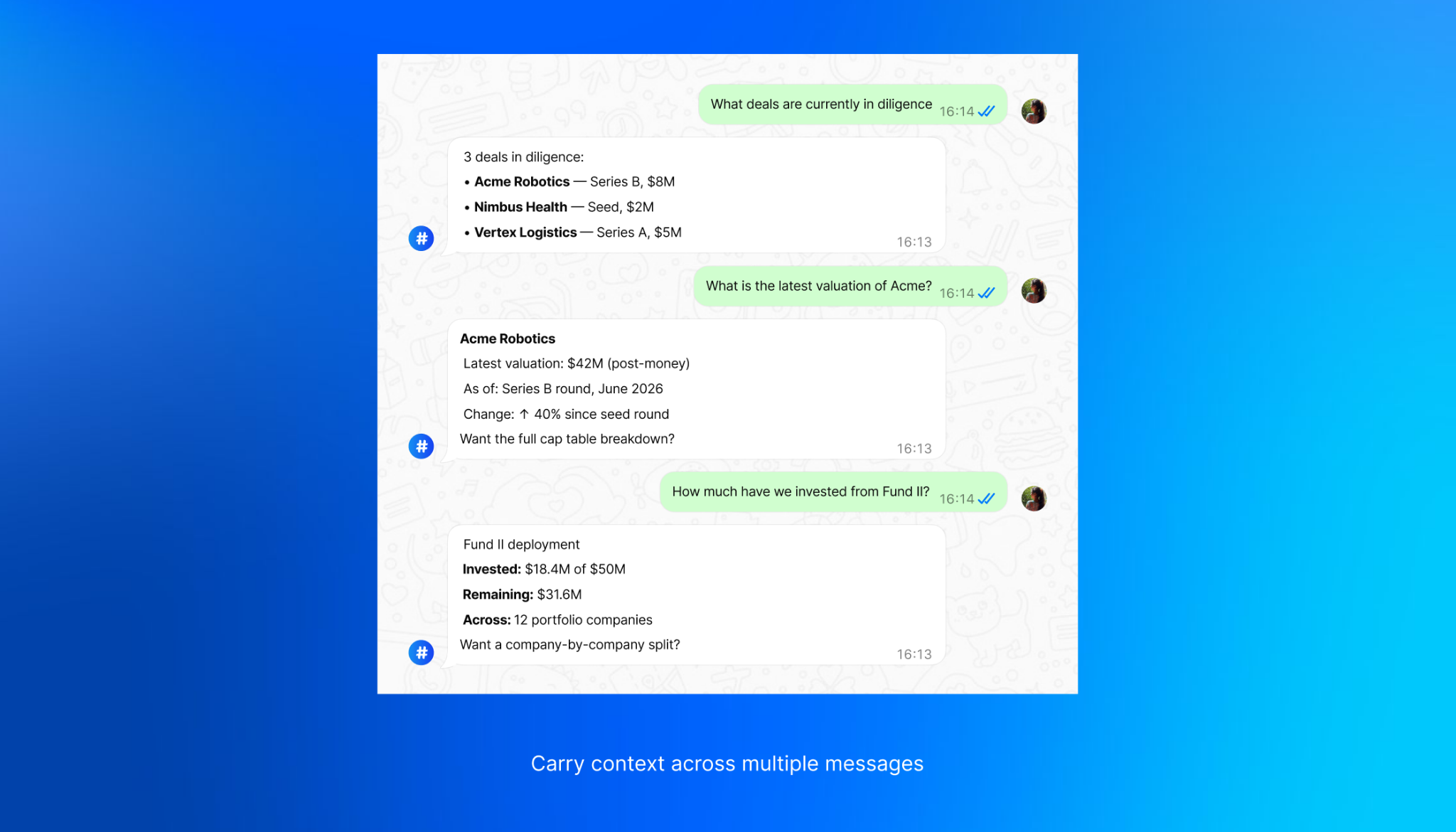
A user can start with a broad question such as what requires attention today, then continue into a specific contact, company or deal without repeating the full background.
For example, the Agent can surface recent deal activity and then continue into the relationship history connected to one of those deals.
This gives teams a conversational way to move through connected workflow context rather than searching one record at a time.
The WhatsApp Agent can continue working with context established earlier in a conversation.
In the demonstrated experience, a user first asks the Agent to research information on the internet and enrich a deal record. The next message only specifies the company.
The Agent understands that the second message completes the earlier instruction.
The same continuity appears later when a pitch deck becomes a new deal and a subsequent voice instruction creates a reminder linked to that newly created record.
This matters because real fund workflows rarely fit neatly into one prompt.
A conversation develops. New information appears. The next action depends on what happened a few minutes earlier.
The Agent helps keep that context connected.
Investment research often happens outside the dealflow record.
A team may review company websites, news, market information and other external sources before manually carrying relevant details back into the investment workflow.
The WhatsApp Agent can research companies and use that information within supported deal-enrichment workflows.
In the demonstrated experience, the Agent researches a company, identifies relevant information and updates structured fields in Taghash. The updated information is then visible in the deal record inside the platform.
The workflow becomes:
research → structured information → enriched deal record
This reduces manual data entry between research and deal evaluation.
External research still requires review. It supports the investment workflow but does not replace diligence or investment judgement.
A pitch deck often reaches the team before a complete deal record exists.
The WhatsApp Agent can connect that document directly with the dealflow workflow.
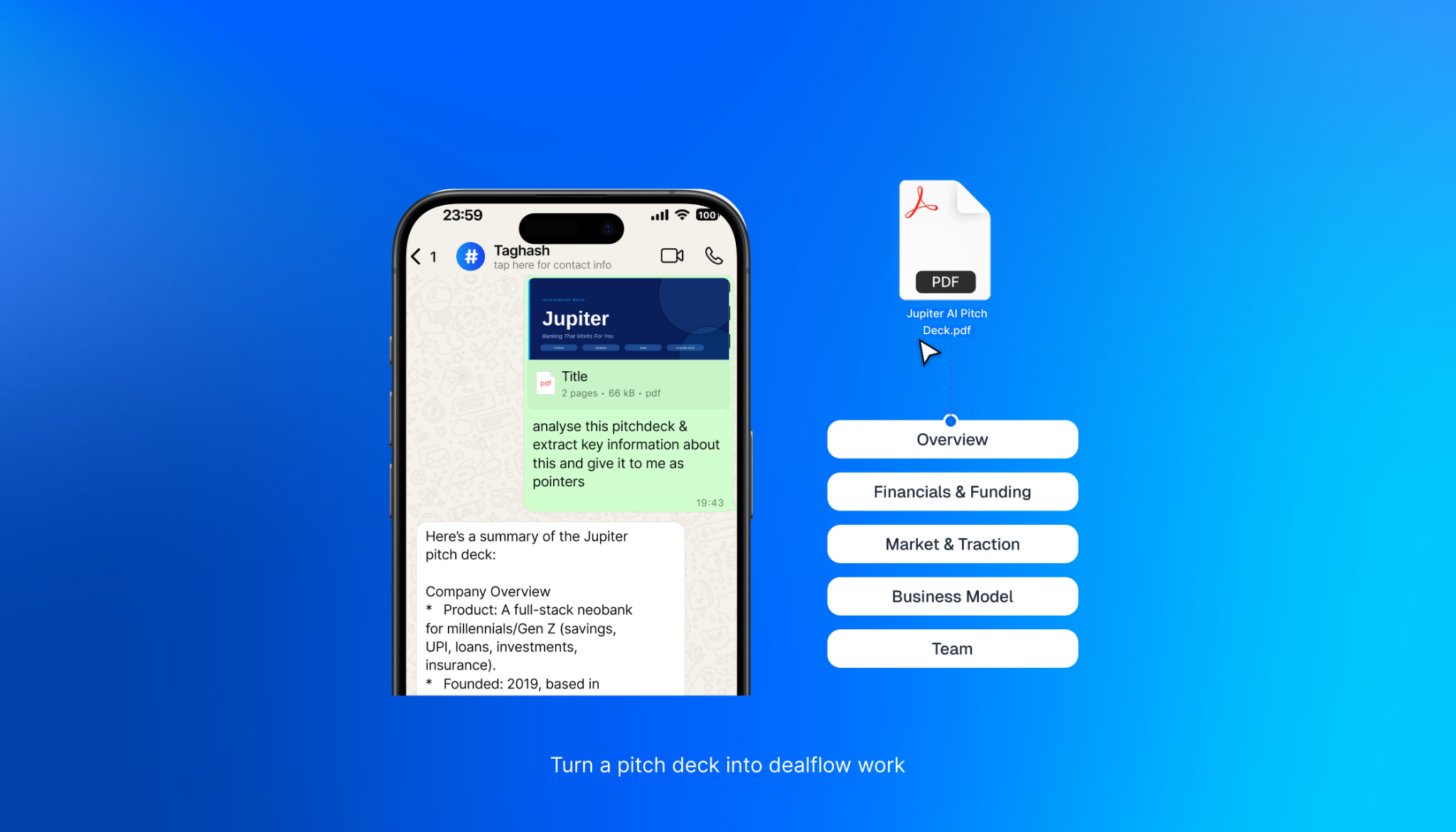
In the demonstrated experience, a PDF pitch deck is shared through WhatsApp with an instruction to add the company to dealflow.
The Agent:
The document becomes part of the deal context the investment team can continue working with.
The user can then carry that same context into the next action without recreating the deal information.
Not every follow-up starts as a typed instruction.
Fund teams often capture context quickly after a meeting, while travelling or between calls. Voice notes can be more practical in those moments.
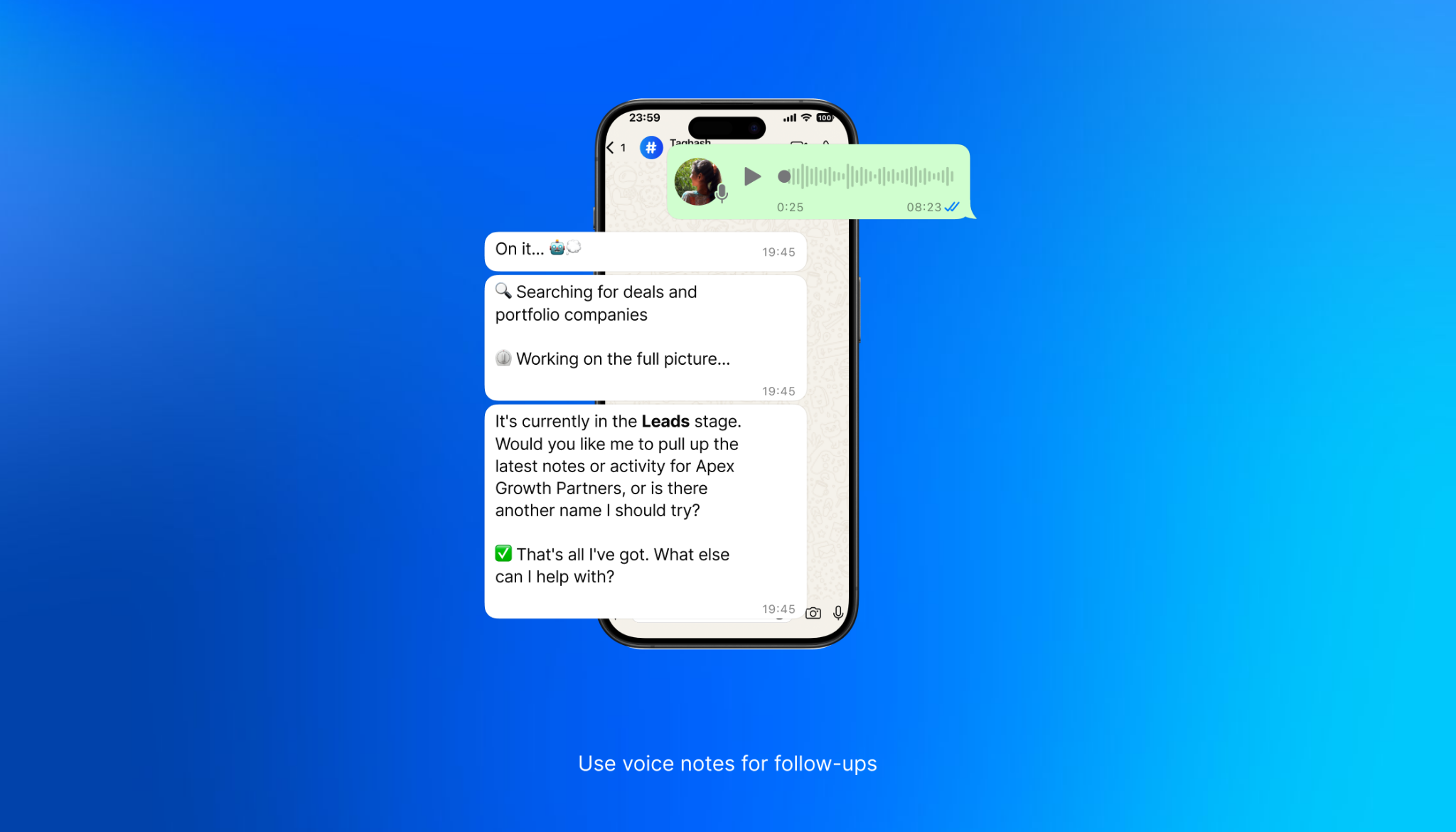
The Taghash WhatsApp Agent can work with voice notes and turn supported instructions into workflow actions.
In the demonstrated experience, a voice instruction is understood and converted into a reminder connected to the relevant deal.
The sequence is straightforward:
voice instruction → relevant context identified → reminder created → reminder connected to the deal
This reduces the need to record a voice note first and manually recreate the task later.
Portfolio monitoring often requires several small steps before the information becomes useful.
Someone finds the relevant MIS, identifies the correct reporting periods, compares the required numbers and prepares a chart or summary for a meeting.
The WhatsApp Agent can work with permissioned portfolio MIS and supported portfolio workflows.
In the demonstrated experience, a user asks for reported revenue versus expenses across the previous four quarters for a portfolio company.
The Agent retrieves the relevant information, summarizes the figures and returns a chart through WhatsApp.
The workflow becomes:
portfolio question → permissioned MIS data → analysis → visual output
This gives investment and portfolio teams a faster route from a question to review-ready information.
Portfolio work often goes beyond retrieving a single number.
Teams may need to compare reporting periods, review investment information, understand operating changes or work with valuation-related records.
The WhatsApp Agent supports portfolio monitoring, MIS, investment tracking and valuation workflows using the Taghash information available to that user.
The Agent can help organize and analyze the relevant context.
Investment and valuation judgement remain with the team.
Some requests require several connected steps.
A team may need to research a company, review competitors, understand market context, organize the findings and prepare material for an internal discussion.
The WhatsApp Agent can work through supported research and analysis tasks and generate outputs such as reports, presentations and charts.
In the demonstrated experience, a broader company-research request progresses through research, analysis and document-generation stages before returning structured outputs to the user.
This is where multi-step workflow support becomes useful.
The user provides the objective. The Agent works through supported steps around retrieval, research, analysis and generation while keeping the relevant context connected.
The Agent supports the work around an investment decision. It does not make the investment decision.
The Agent works with three main sources of context.
Depending on the user's access and the workflow involved, the Agent can work with information related to:
Access follows the permissions already assigned to the user in Taghash.
Users can introduce new context or instructions through text, voice notes and documents.
A pitch deck can become structured deal context.
A voice instruction can become a reminder.
A short follow-up message can continue a request already in progress.
The conversation becomes part of the workflow instead of remaining separate from it.
The Agent can also research companies using external information when the user requests it.
That research can support deal enrichment, competitor analysis and other supported workflows.
External information should be reviewed before it is relied on for diligence, valuation, reporting or an investment decision.
Consider a common dealflow workflow.
A pitch deck arrives on WhatsApp.
Someone downloads it, researches the company, creates a deal record, adds the relevant details, uploads the document again and creates a reminder for the next step.
None of these activities is especially complex on its own.
The friction comes from moving the same context between them.
With the WhatsApp Agent, supported parts of that sequence can remain connected to the same Taghash workflow.
The user can share the document, create or enrich the deal and add a follow-up while keeping the underlying record connected.
The same principle applies to portfolio work.
Instead of locating an MIS file, identifying the correct quarters, comparing the numbers and preparing a chart separately, the user can ask for the required view against the permissioned portfolio information already maintained in Taghash.
The team still reviews the analysis and makes the decision.
The Agent reduces manual coordination and the need to rebuild context around that work.
The demonstrated pitch-deck workflow shows how context can continue across several actions.
A pitch deck is shared through WhatsApp.
The user asks the Taghash WhatsApp Agent to add the company to dealflow.
The Agent reads the document, identifies relevant company information, creates the deal record and connects the original deck to that record.
Later, the user sends a voice instruction for a follow-up.
The Agent identifies the relevant deal context and creates a reminder connected to the same record.
The sequence becomes:
pitch deck → deal record → source document → voice instruction → follow-up reminder
The useful part is the continuity.
The user does not need to recreate the same company and deal context at every stage.
Fund information can include sensitive deal records, portfolio financials, LP data, documents and internal workflow context.
The WhatsApp Agent follows the user's existing Taghash permissions. A user can only work with information available within those permission boundaries.
External communications, generated outputs and changes to Taghash records remain subject to user review and approval.
Taghash operates on SOC 2 certified systems and controls, supported by regular VAPT reviews and ongoing monitoring. The platform also supports role-based access control, encrypted data protection, audit trails and secure integrations.
Conversational access does not remove existing permission boundaries.
AI-generated research, summaries, charts, documents and communications should be reviewed before they are relied on or shared externally.
The Agent can reduce manual work and improve workflow continuity, but it does not replace:
The Agent helps teams work with information and move supported workflows forward.
The final judgement remains with the people responsible for the decision.
VC firms, PE firms and fund teams already receive deals, documents, updates and follow-ups through conversations.
The Taghash WhatsApp Agent connects those conversations with the records and workflows already maintained in Taghash.
Teams can ask questions, introduce new information through documents or voice, research companies and move supported actions forward while keeping the resulting records, permissions and workflow context connected.
WhatsApp becomes another way to work with fund context. Taghash remains the connected operating layer and system of record, keeping records, documents, permissions and workflow context connected.
About Taghash
Taghash provides an end-to-end platform for venture funds, private equity, fund of funds and other alternative investment funds. Over the last seven years, we have served as the tech arm for top VCs, helping them manage operations across deal flow, portfolio, fund and LP management.
We also offer a suite of services like Contributor onboarding/servicing, Fund accounting, Fund administration, Compliance Management, Reporting & Portfolio management and Tax compliance.
Trusted by leading fund managers like Blume Ventures, Kalaari Capital and A91 Partners, we enable our clients to achieve greater success. Click here to book a demo.
View all

For AIFs subject to the annual PPM compliance audit, 30 September 2026 is the reporting deadline for FY 2025-26. This guide covers audit applicability, exemptions and the key considerations for fund teams preparing for the deadline.
LP consent involves more than collecting votes. This blog explains how AIF teams can manage investor selection, voting rules, weighted approvals, reminders and audit-ready records through a structured LP consent workflow.
IFSCA has introduced the Fund Management (Second Amendment) Regulations, 2026, bringing changes across Venture Capital, Restricted and Retail schemes. This blog covers the key updates to pre-close deployment, NAV and portfolio reporting, FME contributions, distribution rights, scheme documentation and governance.