


SEBI’s November 2026 AIF Master Circular brings together several regulatory developments affecting AIF Managers. This guide breaks down the key changes and the operating workflows fund teams should review.

Tanupreet Kaur
Nov 6, 2026
-
12
min to read

Category I, Category II and Category III AIFs, Angel Funds, AIF Managers, Sponsors, Trustees, Custodians, Depositories and Registrar and Transfer Agents. Applicability varies by provision, fund category and structure.
The Securities and Exchange Board of India (SEBI) updated its Master Circular for Alternative Investment Funds (AIFs) on November 5, 2026. SEBI currently lists the AIF Regulations as last amended on October 15, 2026.
The Master Circular should be read together with the SEBI (Alternative Investment Funds) Regulations, 2012 and any subsequent circulars or amendments applicable to the fund.
Originally issued on June 3, 2026, the Master Circular superseded the May 7, 2024 version. The November update incorporates four subsequent regulatory developments from 2026:
The November 5 update incorporates the revised Accredited Investor framework, including Manager-led accreditation, updated eligibility criteria, governance safeguards and rules for withdrawing consent to accreditation-related benefits.
It also brings together GARUDA, the revised Angel Fund Accredited Investor timeline, provisions for retaining proceeds during winding up and the framework for Inoperative Fund status.
For fund teams, the practical impact goes beyond understanding individual regulations. Investor records, supporting documents, scheme-launch processes, reporting calendars and closure workflows may all need to reflect the updated requirements.
A Manager may determine an investor's Accredited Investor status at onboarding or during the tenure of a scheme after verifying the prescribed eligibility criteria.
Manager-led accreditation is optional. The existing route through recognised Accreditation Agencies continues.
Where an investor already holds a valid certificate from a recognised Accreditation Agency, the Manager must rely on that certificate during its validity instead of making a fresh determination.
Accreditation determined by a Manager is valid for three years from the date of accreditation.
The determination may also be recognised by Managers belonging to the same Group for AIFs, Specialized Investment Funds and portfolio management services during that period.
The Manager must communicate the investor's accreditation status, accreditation date and validity period in writing.
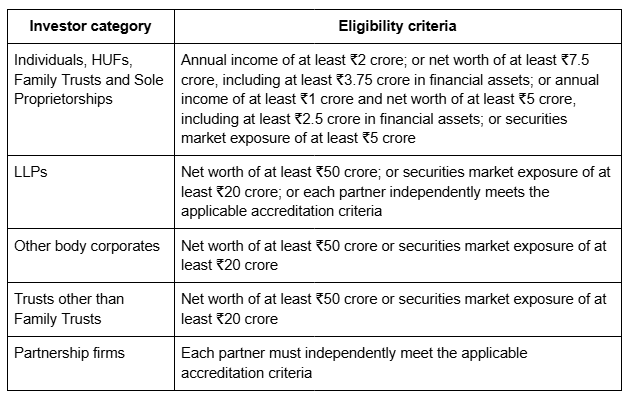
For individuals, HUF Kartas and sole proprietors, the value of the primary residence is excluded when calculating net worth.
The framework also contains specific rules for joint holdings and deemed Accredited Investors.
Managers using this route must maintain a structured verification and governance process. This includes supporting documents and verification evidence, periodic internal audit and compliance reviews, a documented accreditation policy, conflict-of-interest controls, grievance procedures and appropriate data privacy, cybersecurity and record-retention controls.
Records should also be sufficient for an independent review of the accreditation decision.
Deemed Accredited Investor status does not reduce obligations under the Prevention of Money-laundering Act, 2002 and related rules, including client due diligence, beneficial ownership identification and applicable source-of-funds requirements.
The revised framework also addresses an Accredited Investor's consent to use accreditation-related benefits.
An Accredited Investor may withdraw consent, subject to the consequences prescribed in the circular.
Where an investor has used a lower-ticket-size benefit, the investment must be increased to the ordinary minimum applicable to the product within the timeframe specified in the client agreement.
Where other regulatory concessions have already been used, existing investments may continue to be treated as investments by an Accredited Investor. Future transactions after withdrawal must follow the framework applicable to other investors.
This flexibility does not apply to investors in pooled products launched exclusively for Accredited Investors where regulatory concessions have been used.
Client agreements should therefore address the use of accreditation benefits, withdrawal mechanics and the resulting obligations.
SEBI's GARUDA framework sets out the process for taking certain AIF schemes from PPM filing to launch.
A Regular scheme may proceed with launch after 10 working days from filing its application with SEBI, unless otherwise advised.
For a first scheme, launch may take place from the date of SEBI registration or after 10 working days from filing, whichever is later.
The PPM must be filed through a SEBI-registered Merchant Banker together with the prescribed due diligence certificate and supporting documents.
The Manager and Merchant Banker remain responsible for the accuracy and completeness of the relevant disclosures and declarations. Filing a PPM with SEBI does not amount to SEBI approval of the PPM.
AI-only funds and Large Value Funds for Accredited Investors are exempt from the Merchant Banker filing route and may launch after filing their PPM with SEBI, subject to the applicable requirements.
Their first schemes may launch from the date of SEBI registration.
Angel Funds are also exempt from filing their PPM through a Merchant Banker and may circulate the PPM to investors from the date of SEBI registration, subject to applicable filing requirements.
For AI-only funds, LVFs and Angel Funds, the prescribed undertaking from the CEO or equivalent person and the Compliance Officer of the Manager remains applicable.
The Master Circular incorporates SEBI's September 7, 2026 relaxation for the Accredited Investor mandate applicable to Angel Funds.
Angel Funds registered after September 10, 2025 must onboard and offer investment opportunities only to Accredited Investors.
For Angel Funds registered on or before September 10, 2025:
An Angel Fund must also onboard at least five Accredited Investors before declaring its first close.
SEBI's June 16 framework addresses cases where an AIF or scheme reaches the end of its permissible fund life but still needs to retain certain proceeds.
Liquidation proceeds may be retained beyond the applicable period where at least one prescribed condition is met, including:
Where investor consent is required, the Manager must disclose the proposed retained amount and estimated retention period.
For residual winding-up expenses, the retention period cannot exceed three years from the end of the permissible fund life.
An AIF with retained monies that intends to surrender its registration may apply to SEBI for Inoperative Fund status.
An AIF without retained monies may also apply where it intends to retain registration solely because of pending litigation and the possibility of a favourable outcome.
Once Inoperative Fund status is granted:
Applicable funds must submit an annual status report on retained amounts and outstanding liabilities to SEBI and investors within 30 calendar days from the end of March each financial year.
The Master Circular consolidates several recurring reporting obligations.
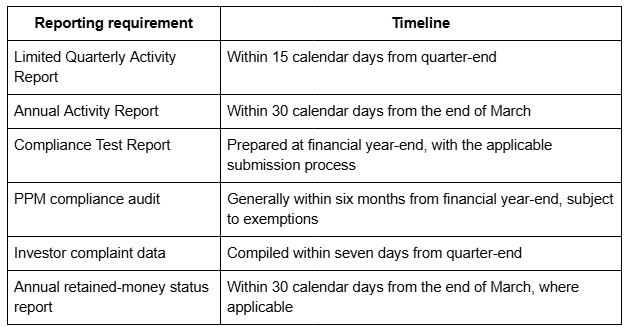
A separate Quarterly Activity Report is not required for the quarter ending March because the Annual Activity Report includes the relevant data.
The Manager must prepare a Compliance Test Report at the end of each financial year covering compliance with the AIF Regulations and applicable SEBI circulars.
For trust-structured AIFs, the CTR is submitted to the Trustee and Sponsor within 30 days from financial year-end. For other structures, it is submitted to the Sponsor.
For AI-only funds, the submission and review requirements under paras 21.2.2 and 21.2.3 do not apply. The Manager must still prepare the CTR and inform SEBI as soon as possible if a regulatory violation is observed.
The annual PPM compliance audit is generally subject to a six-month timeline from financial year-end, with specified exemptions.
These include:
The Master Circular also consolidates core investor-onboarding requirements.
For foreign investors, Managers must consider the prescribed jurisdictional conditions, including relevant IOSCO or bilateral information-sharing requirements, subject to stated exceptions.
Investors and their beneficial owners must also be assessed against applicable United Nations sanctions and FATF-related jurisdictional restrictions.
Other requirements include:
If an investor later stops meeting the prescribed onboarding conditions, the Manager cannot draw down further capital from that investor for making investments until the conditions are met again.
The PPM must contain prescribed disclosures, including:
Disciplinary history generally covers the preceding five years. Where monetary penalties are involved, disclosure applies where the penalty is greater than ₹5 lakh, subject to the circular's exclusions and conditions.
Investor complaint data must be maintained scheme-wise and compiled within seven days from quarter-end.
The Master Circular also brings together requirements across several other parts of the AIF operating cycle, including key investment personnel, overseas investments, co-investment, dematerialisation, fund tenure, changes in Sponsor or Manager, borrowing, valuation, investor rights, due diligence, performance benchmarking, unliquidated investments and migration of eligible legacy Venture Capital Funds.
It also contains prescribed annexures covering templates, certificates, disclosures and reporting formats.
The relevance of each provision depends on the fund category, structure and schemes involved.
The November update makes several workflows worth reviewing:
The applicable requirements will depend on the fund's category, structure, schemes and circumstances.
Regulatory requirements create recurring work across investor records, fund data, reporting calendars, documents, approvals and supporting evidence.
Taghash is a software platform and connected operating layer for private capital teams. It helps AIF teams keep investor records, capital activity, reporting workflows, fund and portfolio data, documents and approval trails connected in one workspace.
For AIF Managers, Taghash can support LP record management, onboarding coordination, capital activity tracking, reporting workflows, investor communications, document management and approval trails.
Where legal, accounting, audit or compliance expertise is required, the relevant professionals can work alongside the Taghash software layer. Taghash does not replace professional advisers or the AIF Manager's regulatory responsibilities.
It helps fund teams keep records, workflow context and supporting information connected, improving visibility and readiness across recurring operating requirements.
For support with AIF operating workflows, connect with the Taghash team today.
View all


SEBI’s November 2026 AIF Master Circular brings together several regulatory developments affecting AIF Managers. This guide breaks down the key changes and the operating workflows fund teams should review.

Valuable investment time is lost moving deal information from sourcing channels into the pipeline. This guide shows how Taghash Zapier automations can reduce repetitive admin and keep deal information connected as opportunities move through the investment workflow.
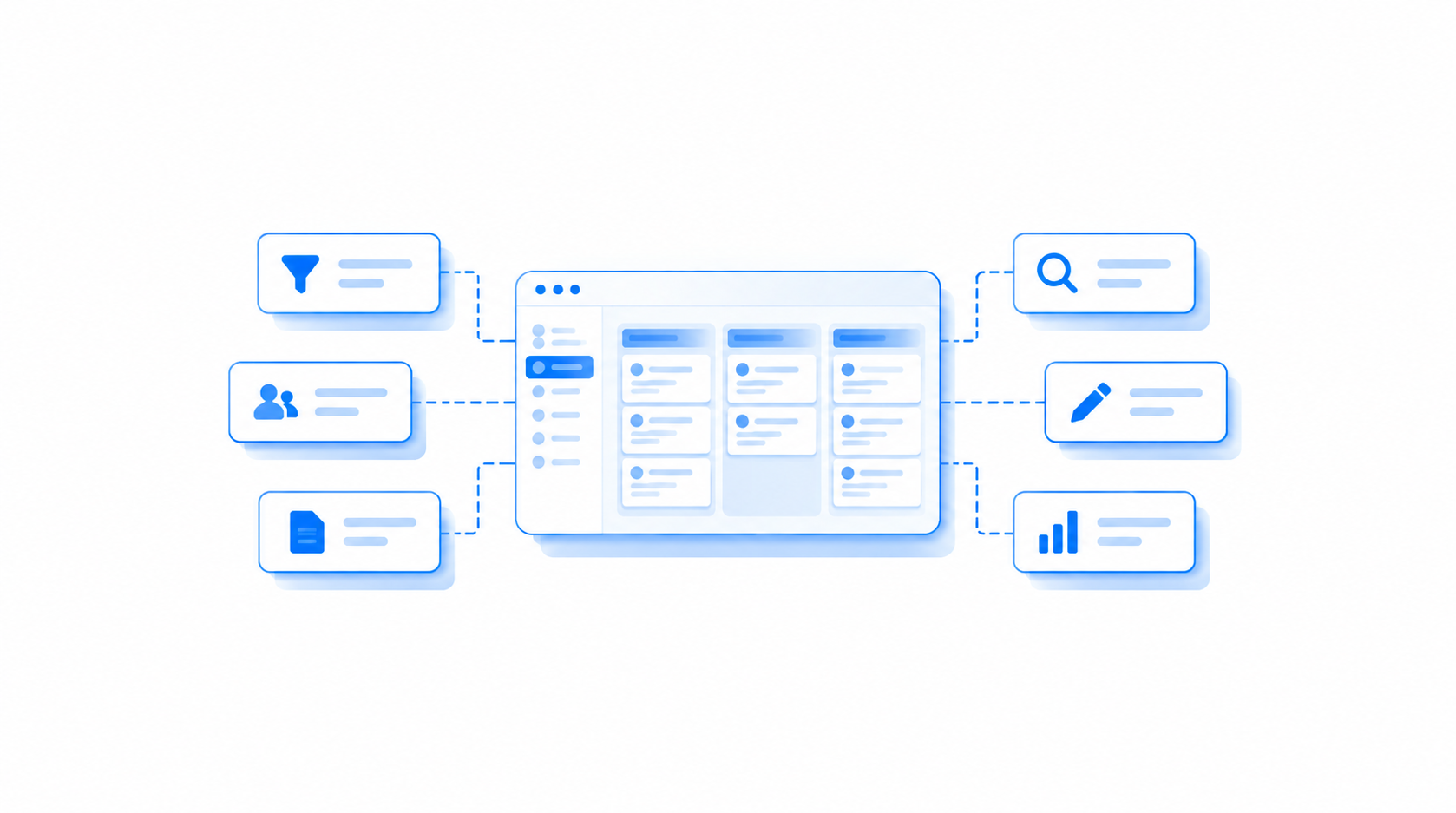
Effective Dealflow management is defined by the small actions investment teams repeat every day. This blog covers six Taghash UI improvements designed to make pipeline review, deal updates and deal context easier to manage.


