


Dealflow timing can change before your pipeline catches up. Taghash Signals brings funding rounds, company news and market updates into your dealflow workspace. Teams can revisit deals, spot new opportunities and prioritize follow-ups with clearer context

Tanupreet Kaur
Jun 10, 2026
-
6
min to read
In private capital, timing changes before the pipeline does.
A company raises a new round. A peer company announces a financing round. A founder comes back with updated traction. A sector draws fresh investor interest.
Each signal can change how the team thinks about priority, timing and follow-up. These updates often get scattered across inboxes, news alerts, articles, databases and individual memory before they reach the next pipeline review.
Taghash Signals brings that context into the dealflow workspace.
It tracks funding rounds, company news and key developments for companies already in your pipeline, along with relevant peer companies that may fit your fund’s mandate. Investment teams can revisit active deals, identify sourcing opportunities and prioritize follow-up with stronger context.
Dealflow changes quickly.
A company that looked too early last quarter may deserve another review after a funding round, major customer win, M&A coverage or sector-level update.
Without a connected dealflow workspace, these updates are easy to miss.
One partner may see the news. An associate may remember the founder call. Another team member may have the CRM note. The team gets full deal context only when those pieces come together.
Signals help connect those dots.
They bring relevant public updates into the pipeline review process, so market context can support sourcing, prioritization and follow-up.
Taghash Signals tracks public funding announcements, news coverage and article-based updates related to deals, tracked companies and comparable peers.
It gives investment teams visibility into updates that may affect company review, category research and opportunity prioritization.
Signals are organized around three signal types.
These are updates on companies already present in your deal pipeline.
When a tracked company raises funding, Taghash can surface that update inside the company record. This helps the team revisit the company with clearer visibility into timing, traction and investor interest.
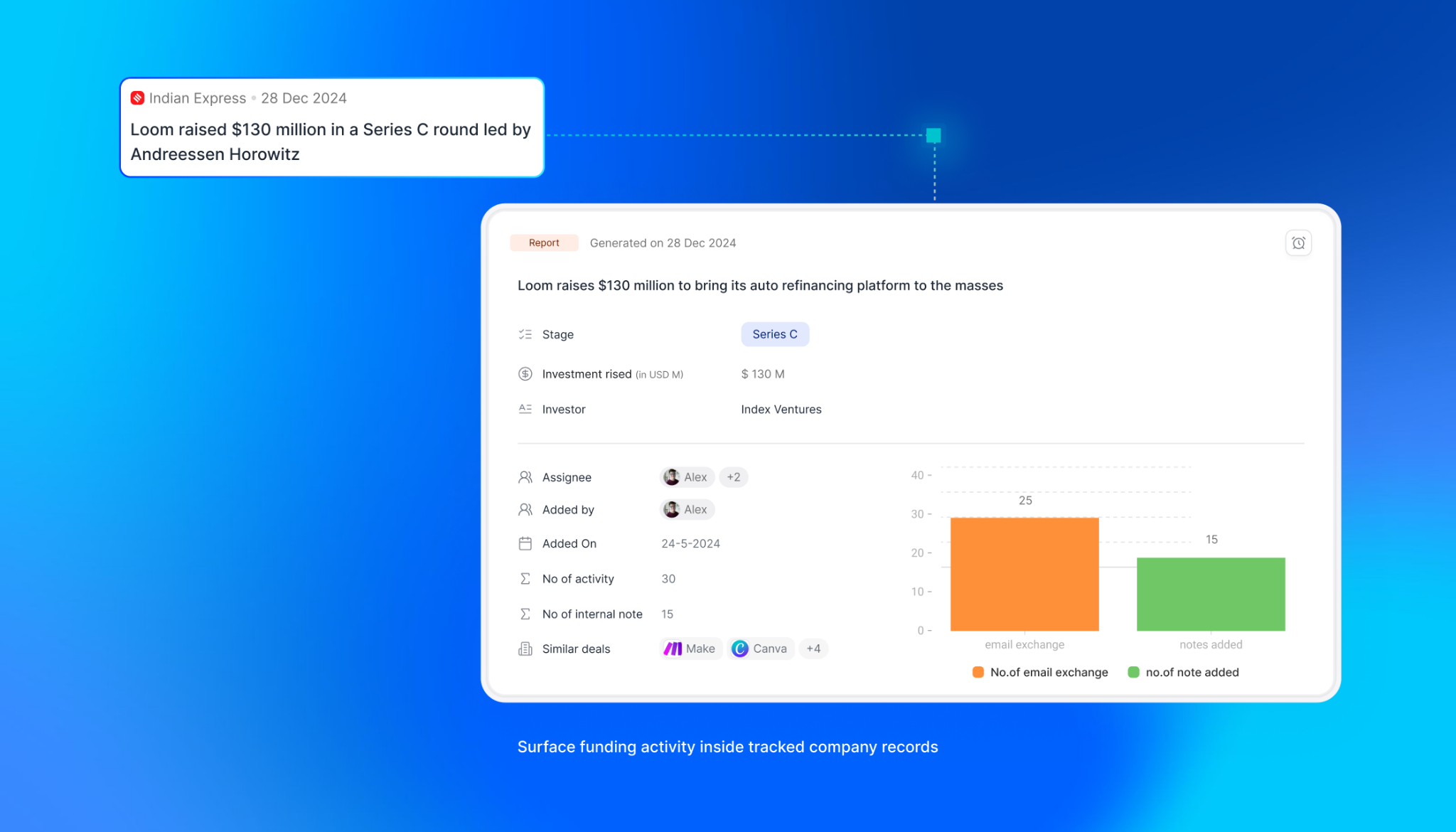
For example, an active deal may have been held in early review. A new funding announcement can prompt the team to check the latest deck, review past conversations, update notes and decide if the opportunity still fits the fund’s mandate.
This supports stronger pipeline discipline. The team does not need to depend only on memory or manual news checks to know when a tracked company has announced a financing round.
Super Signals surface companies that may be relevant to your fund, even if they are outside the existing dealflow.
These companies may operate in the same category, sector or market theme as deals your team is already tracking. If one of them raises funding or appears in relevant public coverage, Taghash can surface it as a potential sourcing prompt.
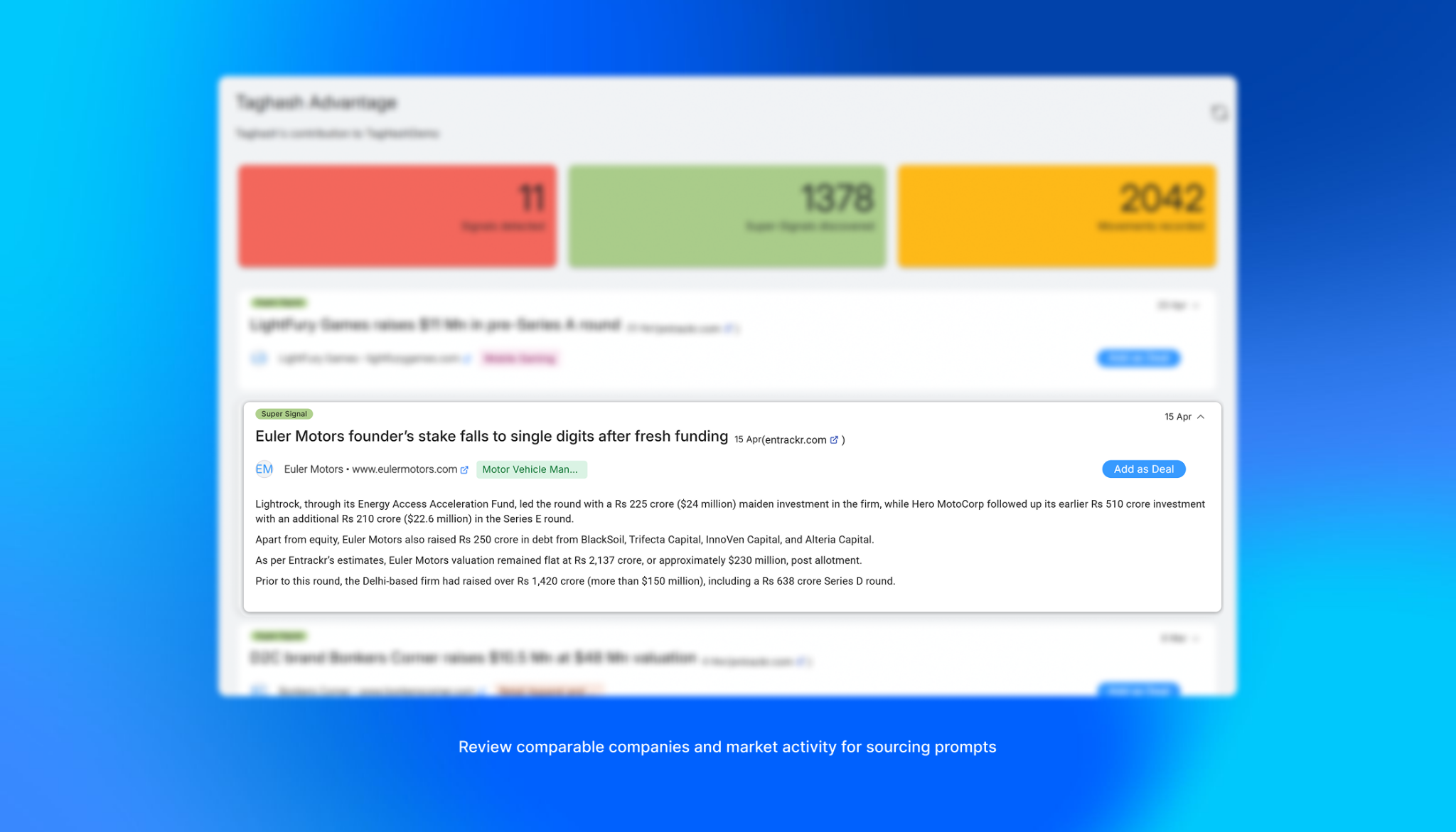
This helps investment teams expand sourcing coverage beyond the existing pipeline.
A Super Signal may point to a peer company, an emerging competitor or a founder the team has not engaged yet. It gives the team a reason to review, research and decide if outreach makes sense.
From there, the team can check if anyone has a warm intro path, compare the company with existing pipeline records and decide the next action with stronger context.
Company Updates track news and article-based updates related to companies in your dealflow or connected market context.
This can include product launches, leadership changes, acquisitions, partnerships, regulatory updates, expansion announcements or other public developments that may affect the team’s view of a company.
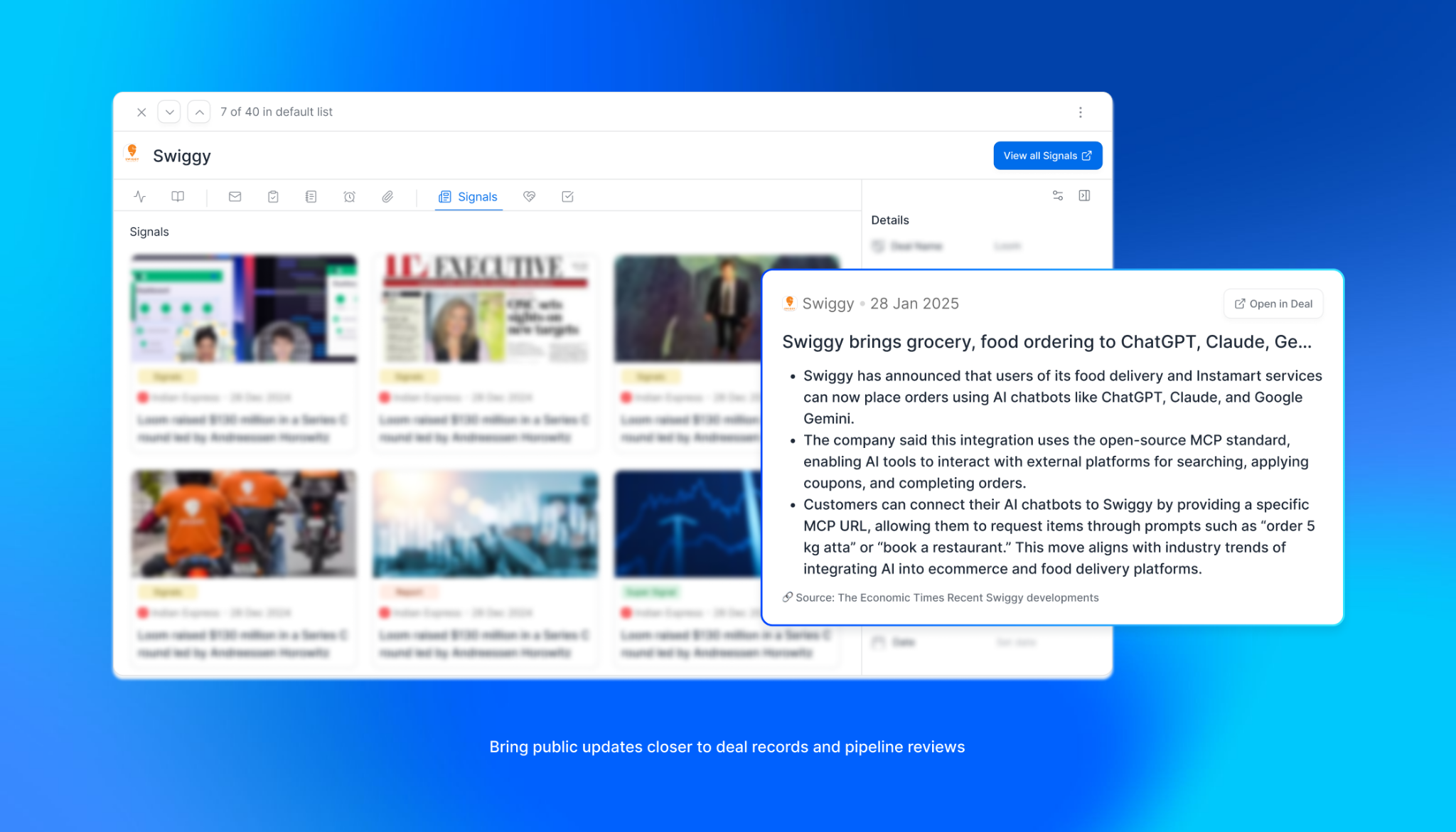
For investment teams, this creates a more current deal record around each company.
Taghash brings relevant news closer to the company record, so teams can use that context during pipeline reviews, founder follow-ups, diligence discussions and internal decision-making.
Signals support investment judgment.
A funding round does not automatically make a company attractive. A news mention does not confirm quality. A comparable peer raising capital does not mean the category is ready for investment.
Signals add deal context.
They help teams ask sharper questions:
Is this company gaining traction faster than expected?
Has a comparable peer raised capital in the same category?
Should we revisit an old founder conversation?
Is there a warm intro path through the firm’s network?
Does this update change our view of timing?
Should this deal advance, stay on watch or be deprioritized?
When those questions are connected to deal records, relationship history, notes, documents and pipeline status, the team can make pipeline decisions with clearer context.
The strength of a signal depends on where the alert appears.
A funding update in a news feed is easy to lose. A funding update inside the company record can shape the next investment action.
Taghash connects signals to the investment operating workflow. Deal records, company context, relationship history, notes, documents, tasks and pipeline stage changes can remain connected in one workspace.
That helps teams carry context forward instead of rebuilding it each time a company comes back into focus.
For investment teams, this helps reduce missed updates, sharpen pipeline reviews and give the team clearer visibility across companies that may deserve attention.
Private capital teams need visibility beyond the companies already on the agenda.
They need coverage across active deals, relevant peer companies and category-level activity.
Taghash Signals helps teams track funding rounds, company news and key developments inside the dealflow workspace. It gives investment teams the context they need to revisit deals, identify new opportunities and prioritize follow-up with a stronger investment context.
Fund operations are complex. Market tracking should not be scattered across news alerts, inboxes and databases.
With Signals, investment teams can bring funding activity, company news and deal context into the same workspace, then make the next pipeline decision with clearer visibility.
Taghash provides an end-to-end platform for venture funds, private equity, fund of funds and other alternative investment funds. Over the last seven years, we have served as the tech arm for top VCs, helping them manage operations across deal flow, portfolio, fund and LP management.
We also offer a services layer to support execution across data management, legal and compliance, fund administration coordination, trustee and custodian interfacing and valuations and advisory.
Trusted by leading fund managers like Blume Ventures, Kalaari Capital and A91 Partners, we enable our clients to achieve greater success. Click here to book a demo.
View all

For AIFs subject to the annual PPM compliance audit, 30 September 2026 is the reporting deadline for FY 2025-26. This guide covers audit applicability, exemptions and the key considerations for fund teams preparing for the deadline.
LP consent involves more than collecting votes. This blog explains how AIF teams can manage investor selection, voting rules, weighted approvals, reminders and audit-ready records through a structured LP consent workflow.
IFSCA has introduced the Fund Management (Second Amendment) Regulations, 2026, bringing changes across Venture Capital, Restricted and Retail schemes. This blog covers the key updates to pre-close deployment, NAV and portfolio reporting, FME contributions, distribution rights, scheme documentation and governance.