


The debate between strategic and financial returns continues to shape how corporate venture capital is approached. This perspective argues for a different way to think about CVC, where investment discipline and strategic relevance reinforce each other.

Shunsuke Nakao
Oct 27, 2026
-
4
min to read

Whenever I attend seminars on corporate venture capital (CVC) in Japan, I am struck by the fact that many operating companies still haven’t resolved the debate over “which takes priority: financial returns or strategic returns.”
In many companies, financial and strategic returns are viewed as “separate entities,” as illustrated in the “so-called Venn diagram” shown below (left). The prevailing mindset is that while a hybrid approach is ideal, if forced to choose between the two, strategy should take precedence.
However, I have consistently maintained the position shown in the figure on the right below—that “strategic returns are encompassed within financial returns.”
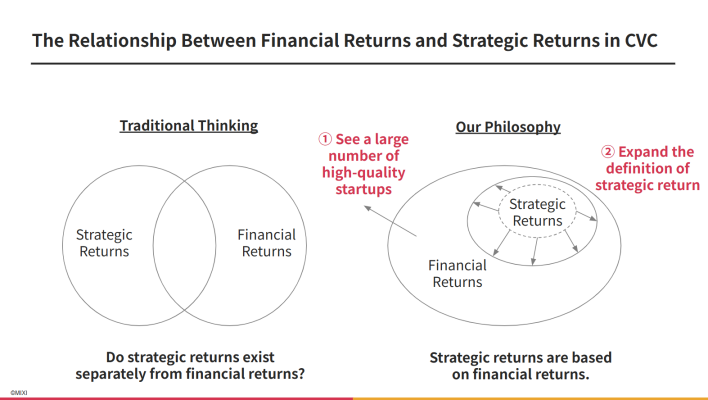
When you think about it, this is perfectly logical. The reality is that the vast majority of startups with no prospect of financial returns (i.e., return on investment) are unlikely to even survive five or ten years down the line. There is no way an operating company can derive long-term strategic returns from companies that fail to gain market recognition and eventually disappear.
Therefore, the proper process for a CVC should be as follows:
In other words, CVCs require broader sourcing capabilities than independent VCs. I would like to do away with the very concept of “financial versus strategic” and the term “hybrid of financial and strategic” itself.
While this way of thinking is gradually gaining traction, it still sometimes encounters strong resistance on the ground. The other day, when I raised this discussion at a meeting at a certain company, the CFO made a strong statement: “Our goal is not to increase capital. We don’t mind if the return on our CVC investment is zero.”
I deliberately posed the following question: “Well then, you don’t have to limit it to Japan—among CVC investments worldwide, do you know of any cases where significant strategic outcomes were achieved from ‘non-top-tier startups’ that failed to generate a financial return?”
The answer was no.
I pressed the issue further: “At your company’s earnings briefings, you state ‘improving ROIC (Return on Invested Capital)’ and ‘improving PBR’ as management policies. How does a policy that accepts zero returns from CVC investments align with your public commitments to investors?”
After the meeting, that executive thanked me, saying, “That was a perspective I’d never considered before. Within the company, we couldn’t escape the shackles of the term ‘strategic return.’” I was truly relieved that we’d been able to have a discussion without holding back.
In the world of CVC, there is nothing more wasteful than the debate over “finance versus strategy.” If such a debate flares up again within your company, please be sure to refer to the diagram and anecdote from this discussion. CVC is, after all, still venture capital. I am convinced that it is the investment activities themselves—at their core—that ultimately yield the greatest strategic results.
About Taghash
Taghash provides an end-to-end platform for venture funds, private equity, fund of funds and other alternative investment funds. Over the last seven years, we have served as the tech arm for top VCs, helping them manage operations across deal flow, portfolio, fund and LP management.
We also offer a services layer to support execution across data management, legal and compliance, fund administration coordination, trustee and custodian interfacing and valuations and advisory.
Trusted by leading fund managers like Blume Ventures, Kalaari Capital and A91 Partners, we enable our clients to achieve greater success.
View all


Dealflow management depends on keeping opportunities visible, active and easy to review. This release brings four updates across everyday workflows to help investment teams work with greater visibility and less friction.

SEBI’s November 2026 AIF Master Circular brings together several regulatory developments affecting AIF Managers. This guide breaks down the key changes and the operating workflows fund teams should review.

Valuable investment time is lost moving deal information from sourcing channels into the pipeline. This guide shows how Taghash Zapier automations can reduce repetitive admin and keep deal information connected as opportunities move through the investment workflow.


